

During the years of my school and university studies, report cards caused me high levels of anxiety but with some underlying optimism. Report cards assumed all-knowing experts were making decisions around my abilities and progress. It would invariably be a measure of success or failure and would expose my weak points and (hopefully) highlight my positive traits. But they always had a judgemental and antagonistic picture in my mind.
My position has now shifted since seeing how report cards can gather useful evidence and potentially affect change. The IGF Gender Report Card initiative proposed by the APC was a first and small but revealing step in measuring representation, visibility, content and contributions from a gender perspective. The Gender Report Card looks at how many women are participating in each IGF session. How many speakers of each IGF session are men or women and to what extent each session does or does not incorporate a gendered analysis.
Using a score card is not a new idea nor is it unique to APC. We were inspired by a similar project initiated by the Women's Initiative for Gender Justice who use the gender report card to monitor the progress of the International Court of Justice.
The initial results of the gender score card initiative has already proved to be a useful instrument in making visible the poor gender “representation” at the Internet Governance Forum (IGF) and the glaring lack of a gender analysis or a women's empowerment perspective in a forum with the theme of 'Internet as a catalyst for change: access, development, freedoms and innovation'. If we are going to see the internet as a catalyst for change in a forum which aims to see the internet as a democratic space, then surely gender should be central to this process? Gender is seen as fundamental to any development process. The IGF as a UN entity with a focus on issues of change and development should, as other UN bodies do, include gender equality and women’s empowerment as a human right and integrate them into democratic governance debates to ensure that women have a real voice in all governance institutions.
As Hafkin pointed out as early as 2003, it is critical that women are involved in decision making and internet governance in order to influence the shaping of policy and if we take the logical next step, in the Internet Governance Forum.
“Project-level data has well established that telecommunication and ICT are not gender neutral. They impact men and women differentially, and, in almost all cases, women have lesser access to and use of the media and lesser representation in the power and decision making positions related to telecommunications and ICT. If ICT and telecommunication were gender-neutral, affecting men and women equitably, then special attention to women would not be necessary. As they are not, such special attention is needed. Without it, women will have fewer opportunities to benefit from the myriad possibilities of the information age.”
There are many ways in which women are differently impacted or have fewer opportunities to benefit from ICTs. Women are not a homogenous group. Access and opportunities are influenced by not only gender but also race, class, geographic location, education, income, time, confidence, (dis)abilities, sexual orientation and many other axes of marginalisation.
For example women living in rural areas where access to ICTs means first overcoming multiple barriers relating not only to their location but also to their gender. Women play a central and pivotal role in agricultural production as well as having responsibilities for caring for families, lower levels of literacy than men, less control over resources and cannot migrate to urban centres as easily as men. This prejudices them more than men from accessing and using ICTs.
Another example is highlighted by Mary Jane Real, a coordinator of the Women Human Rights Defenders International Coalition (WHRD IC), who talks about the opportunities, challenges and digital security risks for women human rights defenders using ICTs. Yet we know very little about gender disparities in the use of ICTs and related security risks, and Mary Jane calls for more research on the ways gender affects the online activism of WHRD. (link to Joy's editorial or interview with Mary Jane).
In one study, focused mostly on use of the internet in the North, “Women on the Web: How Women are Shaping the Internet” out of every 100 online users, 46 are women and in the sphere of Social Media, women are significantly ahead of men. Despite that debates concerning cyber security or protection of the right to privacy of ICT users pay little attention to women's needs and rights, especially in regards to emerging forms of technology mediated violence. For example discussions concerning protection of ICT users privacy and safety need to go beyond the role of State and private sector. In the context of violence against women, such as cyberstalking, manipulation of personal images or sexual harassment, women are especially at risk from violation of their right to privacy and security by private individuals.
The IGF gender report card is a confirming contribution in challenging the poor gender “score” of the IGF and will hopefully lead to some kind of of positive response. In light of the resolution of the UN Human Rights Council – with support by over fifty countries – to establish an expert panel on human rights and the internet, taking gender seriously and redressing the poor representation by women would be a logical inclusion. There can be no human rights without including women's rights.
APC believes that the internet is a critical space in the struggle for fundamental rights and freedoms. But the barriers to participation include a lack of political engagement by women's movements and the lack of government machinery looking at women's rights in the area of internet governance. And as says APC WNSP and Alternative Law Forum in their join briefing document to the 5th IGF in 2010 “this stems partly from the need to build capacity in this area, and partly from the failure of integrating women's rights issues into the forum's analysis and debates. The field of internet and information communications technologies have also evolved with a strong gender bias, with few women holding decision making positions whether in government or in the private sector.”
It is also a responsibility of all stakeholders to raise more issues related to women in the discussions of the IGF thus, making them much more relevant and visible in the debates. Two relatively successful events happened at IGF2011. A Women and Internet Governance roundtable was hosted on the first day organised by Kenya ICT Action Network (Kictanet) plus the Kenya ICT Board, the Association for Progressive Communications, the International Chamber of Commerce (ICC) and Verizon. It was a well attended event which raised the topic of gender inclusion on the IGF and IG gender related issues. However the connection from this to the main sessions is missing.
Second event was a Dynamic Coalition on Gender equality and women's rights meeting which came up with a statement to bring to the attention of the 6th UN IGF the continued gender imbalance in both the participation and the substance of the discussions.
A Jac SM Kee says “It really depends on who is contributing to the conversation. Unless you specifically invite women's rights advocates to speak about human and communication rights issues from women and sexual rights perspective this perspective is absent. Besides of the designed planning you can definitely say that there was no women's perspective. Other workshops that I've been around about freedom of expression, around privacy, around surveillance, didn't have this perspective, it was pretty invisible. Even though if rights were talked about and how critical the internet was in the defense of democracy, public participation, or citizenship the specificity of people's needs was missing.”
Bodies such as the Multi-stakeholder Advisory Group (MAG)or the IGF Secretariat who can influence this should be lobbied to take gender which is an integral part of any development seriously and to institutionalize gender and women's participation a much more in the planning of the next IGF.
More about the author: A South African feminist activist who has regionally and globally on the issue of women's right to communicate and ICTs for social change and women's empowerment since 1994. Jennifer currently coordinates APC's work in supporting women human rights defenders use ICTs securely through capacity building. This is part of the APC Connect Your Rights! project which documents trends, lobbies for internet rights and assists activists in using the internet securely. Jennifer believes that using methodologies such as digital storytelling and the Gender Evaluation Methodology, we can create, track and improve women's access to and use of technologies for change in a meaningful way. And hopefully influence policies which mitigate against a free and open internet. She lives in South Africa.
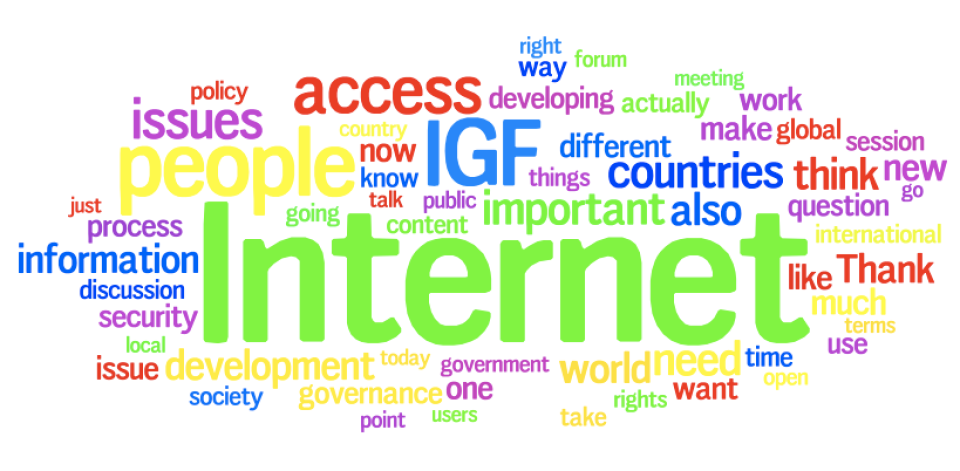
'Text cloud' image by the IGF secretariat. A Text Cloud illustrates the frequency of words found in the main session transcripts of first five IGF meetings from 2006-2010.
- 8998 views



Add new comment