

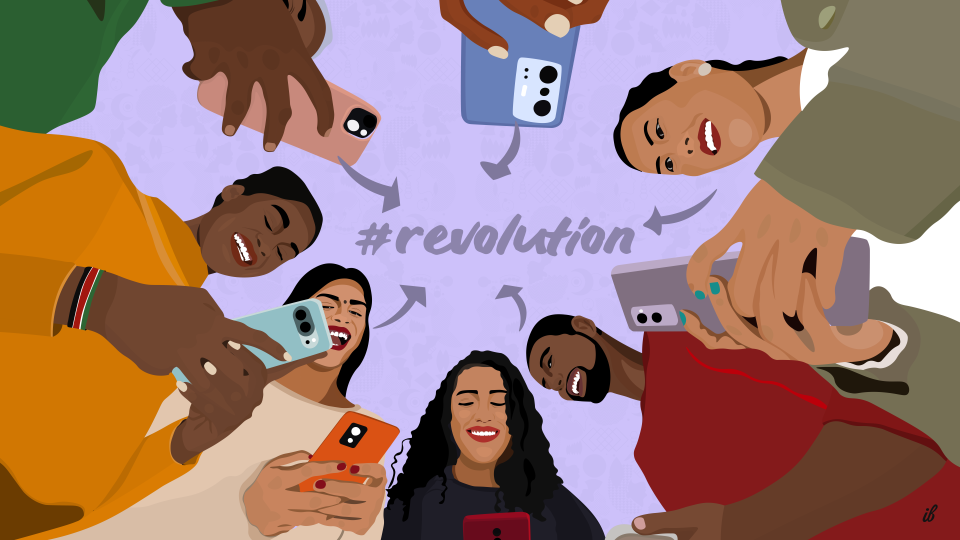
Illustration by Ibrahim Kizza for GenderIT
Back in November 2014, while doom scrolling through Twitter, I stumbled upon the hashtag #MyDressMyChoice and got swallowed into the digital feminism rabbit hole.
At that time, women in Kenya were being attacked for rejecting the unwanted crass advances of makanga (matatu or privately owned minibus touts), and for dressing up “indecently” according to the Kenyan puritan fashion police, because any deviation from enforced patriarchal “modesty norms” could subject a woman to being publicly targeted.
Repeated incidents that occurred in October 2014 with little to no state intervention meant that women would have to speak up for themselves – and they did. Their loud and unapologetic voices led to some sort of feminist revolution years later.
The hashtag #MyDressMyChoice was a call for a nationwide street protest against these violations. As a young feminist, I joined hundreds of women in Nairobi to call out this injustice which profoundly influenced my understanding of feminist activism.
This experience, sparked by that simple hashtag, introduced me to some really cool feminists, and marked a pivotal moment in my journey into community organising and direct action.
Almost a decade later in January 2024, women and other structurally silenced persons, many of whom were also involved in the #MyDressMyChoice march in 2014, were back on the streets protesting against femicide.
This was the second time in five years that women and gender minorities would come together to protest against intensifying violent conditions. Kenyan feminist collectives from across the country had done a spectacular job mobilising communities using the hashtag #TotalshutdownKE.
The impact of #TotalShutdownKE sparked conversations on social media on how the hashtag could be a pivotal tool in agitating for social change in Kenya.
Online campaigns enabling access to mobilisation
The months of June, July and August 2024 were quite tumultuous yet a transformative phase in the country's political landscape. This era witnessed a surge of youth-led political uprisings dubbed the “Gen-Z movement” that leveraged social media as a powerful tool for mobilisation, advocacy and citizen journalism.
The uprisings began in response to a controversial finance bill proposed by the government, which many believed would exacerbate the economic disparities faced by ordinary Kenyans. The International Monetary Fund (IMF) backed bill was perceived as a direct threat to the already strained financial stability of the country, and especially the poor demographics that mainly consists of women and children.
Technology played and continues to play a crucial role in catalysing, shaping and sustaining the resistance across the continent.
As the protests blew up on the streets and gained nationwide momentum for weeks, our grievances garnered international attention and concern. The state and its agencies doubled down by responding to mostly peaceful and unarmed youth with unbridled violence, abductions and explicit threats. Social media platforms became the battlefield for a new, parallel, digital form of resistance countering ubiquitous, and quite frankly, lazy government propaganda.
These were unprecedented times. Much like the Arab Spring that swept across the Middle East and North Africa, and the #EndSARS protests in Nigeria, technology played and continues to play a crucial role in catalysing, shaping and sustaining the resistance across the continent.
Women, queer activists and other historically marginalised, structurally silenced groups who are often excluded from mainstream political discourse, impressively harnessed the power of social media to amplify their voices.
From TikTok skits to Instagram stories and Twitter threads, the movement was marked by innovative uses of digital platforms to mobilise support, disseminate civic and political education and provide mutual aid.
As someone who has become uncharacteristically anxious after an online bullying incident, being able to have both the choice to participate in direct mass action on the street and supporting the movement online has been great.
These digital communities provided a platform to a lot of the people living with various disabilities or social impediments who were/are unable to show up in the streets to express themselves.
Yet, these platforms that give us the false promise of freedom of speech and expression have often exposed us to surveillance, extraction, harm and violence.
Tonia*, a trans woman living in Nairobi, explained to me how the internet offered her a safety net that allowed her to still play a role in the movement. She said, “The internet really came through for me as I was able to participate in the protests remotely without having to go to the streets as it is dangerous for a trans woman like me to be seen outside.”
The hashtags #RutoMustGo and #Rejectfinancebill became rallying cries not just for the youth but for various activist communities especially those structurally silenced who now had the opportunity to actively participate in the country’s political discussions without having to put themselves in highly visible spaces, and now had alternative ways of supporting the movement while maintaining some level of control, privacy, and even anonymity.
My feed across all social media platforms is meticulously curated so I mostly come across posts created by feminists and queer rights activists. During the protests, I loved seeing how my community turned that cesspool platform Twitter, owned by an insufferable billionaire and apartheid apologist, into a virtual public square for civic and political education. My feminist friends and queer niblings really showed up and showed off. They used digital platforms to disseminate crucial information about the finance bill and its implications.
I was in awe of the creative infographics, short videos, and live discussions that helped demystify complex legislative language, making the issues accessible to a broader audience.
Safety nets were and continue to be a critical aspect of digital resistance, and especially for structurally silenced groups.
Digital community-led safety net amidst violence
In the face of state violence and repression, mutual aid became vital for the digital activism scene. Women and queer communities leveraged their networks to provide immediate material support and resources to those affected by the uprisings. Online platforms were used to coordinate food drives, medical assistance, and emergency housing for activists facing threats, stalking or displacement. Mutual aid requests were circulated through social media, allowing individuals to contribute resources or offer support. This grassroots solidarity was crucial in maintaining the momentum of the protests and ensuring that marginalised groups had the support they needed to continue their activism.
Safety nets were and continue to be a critical aspect of digital resistance, and especially for structurally silenced groups.
Community is everything. Activists and direct-action community organisers developed online tools and resources to help individuals protect their digital privacy and safety. Guides on how to secure communication, data protection, and navigating online harassment were shared widely, helping to shield activists from state surveillance and attacks.
Shout to Access Now for all the free VPN codes and digital safety flyers and webinars.
This was the first time in the history of this former British protectorate that the citizenry exerted their power in numbers by using technology to push back against violence, challenge state hegemony, policing the police, shaping public opinion, calling for accountability, and spotlighting and boycotting individuals and businesses in a way that has never been witnessed before.
For instance, when 29-year-old Rex Masai was shot and killed by the police on June 20, 2024, he became the first victim of the Finance Bill 2024 protests. His death caused public outcry, and social media became a space to grieve, gather in the digital square and demand #JusticeforRex.
After all the backlash they received on social media for their inaction, The Independent Policing Oversight Authority (IPOA) – a civilian oversight authority on police in Kenya – issued a statement claiming that they would investigate Masai’s death and numerous documented abductions by police, but their nonchalant and outright disinterest in investigating the violent actions of the police since the death of Rex in June 2024 is a clear indictment of their complicity in state violence.
When my good friend S* was arbitrarily arrested and detained across various police stations in Nairobi all in one day, it was social media that helped us secure her release. The police were not enjoying the negative press and had to let her go.
It was mainly women and queer activists actively calling upon public figures to lend their voices to the cause.
In the early days of the protests, some businesses were recognised and rewarded for their support of the movement. Certain establishments allowed protesters to take shelter during clashes with police, earning widespread patronage from the community. Digital influencers and celebrities were also drawn into the fray.
It was mainly women and queer activists actively calling upon public figures to lend their voices to the cause. However, some influencers faced swift backlash and were expeditiously 'cancelled' for declining to support the protests.
Unsafe narratives
One thing about the two-headed beast: patriarchy & capitalism, is that it will always rear its ugly head even in supposedly progressive spaces.
The state and its affiliates tried to undermine the movement by weaponising our identities. The ethnic and religious angle just wasn’t cutting it anymore, so they had to adapt with the times. They attempted to weaponise the already precarious identities of feminists and queer folks using them as scapegoats to shift public scrutiny away from state violence and mismanagement.
Narratives framed queer activists as foreign agents and many protesters were portrayed as sponsored extremists, justifying violent crackdowns and attempting to fracture the protest movement.
Eventually, this led to homophobic and misogynistic rhetoric and the self-censorship of feminists, queer persons and other structurally silenced people with little to no support from their supposed “allies”.
More shocking, is how the loudest misogynists on Kenyan social media somehow emerged as the defacto ‘leaders’ of the revolution.
During this period, dis/misinformation was a huge obstacle. The state is particularly notorious for engaging in campaigns to spread false information about the protests, activists, and the financial implications of the bill.
It also didn’t help that supposedly “progressive” voices were actively participating in the dis/misinformation craze on social media by either embellishing the truth or outrageously claiming, without concrete evidence, things like how the state had allegedly arrested and cremated hundreds of protestors at the military barracks, and that the police were using a toxic chemical by the name ‘agent orange’ which was apparently discontinued by the manufacturer years ago.
Rage baiting was widespread. Social media became a battleground for countering these lies. Activists fought back with fact-checking, collaborations with independent media, and debunking efforts, striving to maintain the integrity of the movement.
A particular incident on June 25, 2024, added to the chaos. Allegedly, a major telecommunications company was accused of stifling internet access at a critical moment during the protests. There were also claims that the company provided personal data of some protesters to state officials. These allegations led to a mass boycott movement against the company, and a call to action to resist capitalist hegemony and fight for digital freedom.
These past months are probably the decades happening in weeks that Lenin was talking about.
Activists fought back with fact-checking, collaborations with independent media, and debunking efforts, striving to maintain the integrity of the movement.
I continue to be highly sceptical and overly cautious while using big tech social media platforms whilst also acknowledging the important role they played in sparking off a people’s movement and building communities.
It could have been algorithm luck, or maybe the conspiracy theorists could be right that everything was orchestrated by the tech bros in this spectacle of a society we live in.
Still, the revolution will be hashtagged. As we continue to fight against oppression and as we explore alternative, liberatory ways of using the internet and imagining a safe digital sphere for those who are structurally silenced, it is important that we occasionally put away our devices, logout, unplug, escape the algorithm panopticon and build communities in real life. We do this till we’re free. Go touch some grass, beloved.
- 149 views


Add new comment