
Publication
[CLOSED] Call for proposals: GISWatch 2026 special edition with Safety for Voices
This document tells you how to contribute a country report proposal for the 2026 special edition of Global Information Society Watch (GISWatch). It also provides background on the Safety for Voices project, details the themes of the special edition, and tells you more about the process of contributing country reports. Deadline: January 15, 2026

In depth
[Part 2] Image-Based Abuse: A Practical Legal Guide to Control The Spread of Content in India
This guide offers practical suggestions for victim-survivors of image-based abuse, especially those living in the global majority world, to remove the violative content while safeguarding their privacy and identity online. It may also be useful for those who support or accompany victim-survivors. This guide contains two parts.

Feminist talk
The Fate of Bangladesh’s Cyber Security Act? A Swift Repeal
Bangladesh's Cyber Security Act replicates the draconian legislative framework that its predecessors imposed on online civil liberties in the country. With the new government in place, activists are demanding for its repeal.

In depth
When Protection Becomes Threat: Cybercrime Regulation As A Tool For Silencing Women And LGBTQIA+ People Around The World
Derechos Digitales maps cases involving the abusive use of cybercrime regulation to silence and criminalise women and LGBTQIA+ people worldwide. The results are troubling and warn of the inherent danger of imposing international standards without considering national contexts or building human rights safeguards, particularly for historically marginalised groups.

A Feminist Conversation on Cybersecurity
This edition focuses on the human dimension of cybersecurity. To do this, the editors asked themselves how cybersecurity policies developed from the centres of political, economic and epistemological power affect those at the margins; and how they can think about cybersecurity from a feminist perspective. The editors set out to find specific and contextualised examples of how cybersecurity…

Feminist talk
Feminist Sparks of Reflection About Digital Forensics
The international forensic community still fails to develop tools and techniques to address women’s needs. Carl, from Marialab, explores how feminist activists in Brazil are working on frameworks for teaching and applying computer forensics in cases of gender-based violence online.

Feminist talk
Feminist Infrastructure: The Creation of What Sustains Us
Our perspectives and conditions of access, use and development of technologies are deeply rooted in the ways patriarchy, capitalism and colonialism are embedded in our daily lives. This article maps pioneering feminist infrastructure experiences that allow us to explore new horizons of political action.
Feminist talk
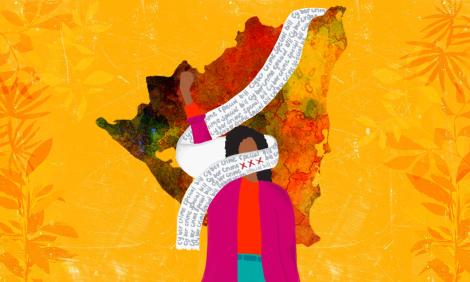
Cybercrime Policy to Censor Dissent in Nicaragua
Nicaraguas’ Cybercrime Special Law, passed under the argument of being the first national instrument to protect women’s and children’s integrity online, is being enforced to silence dissenting voices. This article illustrates how the Ortega-Murillo regime has instrumentalised this bill to curtail freedom of expression, criminalise human rights defenders and silence feminist activists in the…

Feminist talk
Localising Digital Self-Defence Guides for Sex Workers
Despite passing under the guise of fighting sex trafficking, the US-based bills FOSTA/SESTA criminalised sex workers and left them fewer tools to work and protect themselves. Cypher Sex describes the challenges of writing digital self-defence guides with protection strategies that could be applied to this legal scenario.

Editorial
A Feminist Conversation on Cybersecurity
Like any other technical domain, cybersecurity has always been confined to senior officials and private sector specialists. Feminists, however, have not only claimed their right to participate in decision-making structures in this field but have made central contributions to the notion of security, bringing holistic and intersectional approaches. In this edition of GenderIT, editors focus on…