
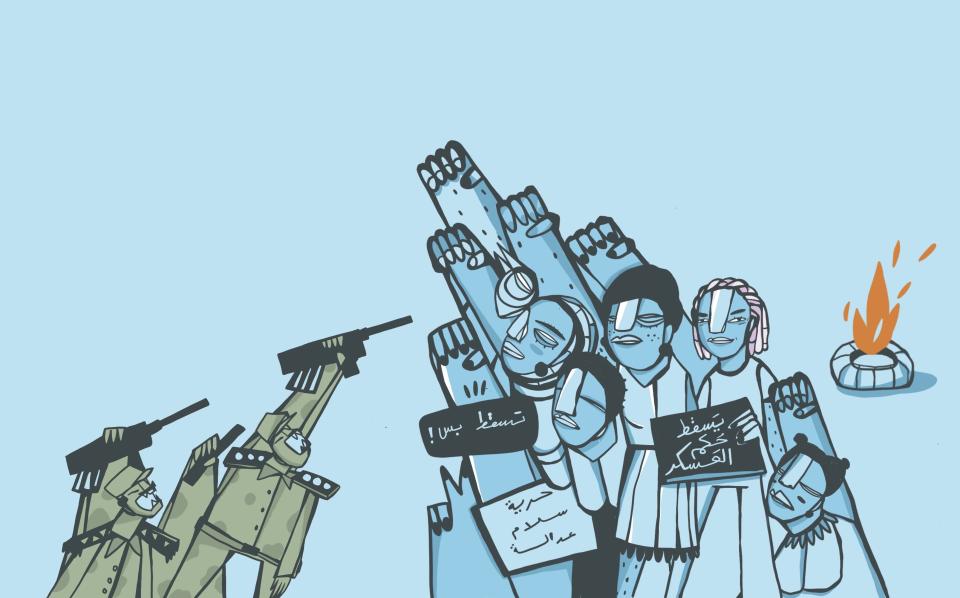
Illustration by Alaa Satir for FIRN.
"تخيل! تخيل لو عندنا حكومة كوير!"
"ياااه يا لهوي !بالضبط. هنقولهم ‘يا جماعة عادي هنسيبكم […] .’والله هنبقى أجدع من أجدع حد فيهم، وحياة ربنا. .. يا ولاد الكلب."
“Imagine! Imagine if we had a queer government!” I joked with Fahd.
“Ya lahwi!” he laughed.
“We’d tell them [non-queers], ‘Guys, it’s fine, we’ll leave you alone.’ […] We would be cooler and better than the best of them. I swear to God.” − Fahd
I intentionally joked with Fahd (pseudonym) to lighten the intensity of our conversation at that moment. It worked − we both laughed. Underneath that laughter, there was anger, pain, and a sense of faith.
My conversation with Fahd was part of qualitative research aimed at unpacking the complex array of political and structural forces that exacerbate gendered violence, including its technology-based manifestations, particularly in Egypt. Ultimately, the research aimed to inform and influence policy and advocacy efforts.
Rather than being exhaustive, this article serves as a starting point for further inquiry into how qualitative research can be a site for community building and perhaps... organising!
In this article, I critically reflect on my experience conducting qualitative feminist research. Specifically, I examine two questions: 1) How political and intimate involvement with research shapes the process and relationship with participants and influences the outcomes; and 2) how qualitative research can maximise beneficence to participants and the broader community − beyond influencing policy-making efforts. I engage with these questions by drawing on conversations with the research participants and debriefs with the research team. Rather than being exhaustive, this article serves as a starting point for further inquiry into how qualitative research can be a site for community building and perhaps... organising!
The system is not broken: A conversation with Fahd
Fahd, an Egyptian in his twenties, is passionate about arts and culture and enjoys spending time with his friends. He works with grassroots organisations that support diverse communities. A few months ago, he reached out to the team expressing his interest in participating in the research. Last October, Fahd and I had a digital conversation that lasted for about 90 minutes.
Throughout the semi-structured conversation, Fahd shared his experiences with gendered violence, particularly digital entrapment, as a queer individual living in Egypt. His account highlighted how a prevailing culture of impunity, the legal landscape and digital infrastructure perpetuate violence. He reflected on the entrenched impunity that must be challenged, as well as conflicting feelings toward the country. He also spoke about the ways he cares for himself and his community as well as his dreams and efforts to benefit his community:
“I feel hurt and angry […] sometimes I think, I want to leave Egypt, let it burn, I wouldn’t care. But then I feel like, where should I go? Why? For what?”
The first experience Fahd chose to share with me was about Sarah Hegazi, an Egyptian queer leftist activist and a fierce fighter for liberation. In 2020, she took her own life in exile in Canada − or rather, she was murdered by a brutal regime. In October 2017, Sarah was arrested days after raising the rainbow flag at a concert by the Lebanese band Mashrou Leila, in what was known as the Rainbow Flag Incident. Detained, tortured, and violated by a criminal regime and a society whose fabric is woven with hatred. Months after her release, fearing another arrest, she was forced into exile.[1]
Following the concert, there was a massive crackdown compounded by both state-sponsored media propaganda and incitement on social media. This led to one of the largest mass arrests of 75+ individuals who were LGBTQI+ or merely perceived to be, most of whom had no connection to the concert. They were prosecuted under the guise of “violating vice laws.” Many others who expressed solidarity or even empathy became targets of repression as well.[2]
Attuning to research participants’ feelings and needs and extending this to researchers is not just a form of care but also a method of rigour.
Fahd was one of the people who were targeted. He shared his experience and the long-lasting psychological and social implications that he is still experiencing. He shared his love for Sarah and recalled the shock at her passing:
"The last time we spoke was when she was travelling. We’d send messages when we had the chance, and the last ones were really kind, just telling each other our feelings, that we loved each other. When I came across those messages later, it really hit me. What happened with Sarah was a huge shock. I just couldn’t make sense of it."
Fahd was not the only participant who brought Sarah into our conversations − other participants did too. I didn’t know Sarah, but like many of us (at least from what I observed in my close circles), we identified with her. Years later, anger and grief remain.
Attuning to research participants’ feelings and needs and extending this to researchers is not just a form of care but also a method of rigour.[3] Thoughtful reflection and thorough documentation of both emotional nuances and intellectual insights can meaningfully inform the research process and outcome.[4]
Throughout my conversation with Fahd, I felt many boundaries got blurred. As if I was no longer a researcher sitting at my desk in a European country, speaking with a research participant through my laptop. For many moments it felt as though I was sitting beside him − two friends sharing grief and anger and searching together for a way forward.
When the conversation ended, I closed my laptop and stepped outside for a walk. I walked for hours, trying to digest this conversation and the tangled feelings it stirred toward the country: the anger, the desire for revenge against a system that deliberately and slowly murders anyone who speaks truth to power. This conversation pulled me back even before 2017, into the reality of the present. A present shaped by the ingrained and intricate powers of authoritarian fascist and nationalist ideologies that legitimise violence to systematically silence opposition both online and offline and punish anyone who challenges the social order they strive to maintain. Deeply ingrained powers that facilitate and reinforce the dominance of Western colonial imperialist forces to serve their interests.
During our conversation, Fahd attributed the violence to the state and a broken system. But I believe the system is not broken; it was built this way. Exposing infrastructures of harm (online/offline) that shape lived realities is what the research aims for. However, I acknowledge the research’s partiality; it does not capture the magnitude of harm in contexts of genocides and conflicts where violence manifests and impacts lives in unprecedented ways.
I believe the system is not broken; it was built this way. Exposing infrastructures of harm (online/offline) that shape lived realities is what the research aims for.
Positionality and process
As part of the Feminist Internet Research Network (FIRN) and hosted by Cairo52 Legal Research Institute, the research examined the lived realities of women and queer individuals with gendered violence, including its technology-based manifestations Egypt. These realities were the point of departure to (a) have in-depth understanding and analysis of the complex array of political and structural forces that exacerbate gendered violence both online and offline; (b) highlight the rights and health ramifications as well as the everyday resistance strategies individuals adopt to thrive; and (c) ultimately, the research aimed to inform and influence policy and advocacy efforts.
I positioned myself in this research as politically and intimately involved − and geographically fluid, alternating between Egypt and Europe over the past two years.[5] In the following sections, I reflect on how my positionality influenced different aspects of the research process such as design, the team involved, and the relationship with participants.
Besides exposing infrastructures of harm, another reason to initiate this research project was to archive and amplify voices of the community. It was a deliberate attempt to counter the systematic erasure of our narratives.[6] However, undertaking such a project as an independent researcher was challenging. An eroded civic space with restrictions on civil society organisations[7] left few options to find a value-aligned host organisation to support the project on an administrative level. Unsurprisingly, the process took more time than expected.
Over time, the research gained a solid foundation and was supported by a network of activists, researchers and academics whose contributions were instrumental to its execution. Some chose to voluntarily offer support at various stages and diverse capacities – from advising on research design to providing safety and security support.
The core team included two researchers who played a pivotal role in supporting data collection and processing, and initial analysis:
- Camillia Kamel: An Egyptian feminist legal researcher based in Europe. Her work focuses on freedom of expression and minority rights in the region.
- Heba Anis: An Egyptian feminist journalist and researcher. Her work focuses on violence against women and minority issues.
Access
The team and I reached out to our professional and personal networks to enlist their support in reaching participants. Additionally, we published a call for participation through the digital platform of the host organisation. The team’s positionality facilitated access to participants. Although we opted for a maximum variation sample, the team’s positionality somewhat influenced the characteristics of those who participated.
Participants were women and queer individuals residing in Egypt, particularly across Delta, Upper Egypt and Cairo, or who had left the country in the past two years. They ranged between 20 and 39 years old. They experienced a form of tech-based violence and/or were actively engaged in an initiative or human or women’s rights organisation concerned with addressing gendered violence in Egypt.
We intentionally refrained from pressuring participants to disclose anything they were uncomfortable sharing, even if such disclosures could have enriched our study.
Relationship with participants
Camillia and I spoke with a large number of participants. We had hybrid (online/offline) individual in-depth conversations and group conversations. The group conversations were meant to take place over four weeks with one session a week. The main goal of these conversations was to create a base for community network and have the time to build deeper connection and rapport, which is not possible in a one-time setting. We also wanted to offer the participants the possibility to create written contributions to be included in the research outcome. Nevertheless, it was extremely difficult to implement this design. Instead, we were able to implement a two-day on-ground conversation with a group of women.
Although we didn’t personally know any of the participants, the way we reached them established a sense of trust. This initial foundation was crucial, allowing us to build upon it and work to create an environment where participants could feel comfortable and at ease.
For example, we attempted to refuse the hierarchical nature of the participant/researcher relationship. This involved engaging in a two-way conversation, sharing more about who we are, and why this issue concerns us. Additionally, throughout our conversations, participants’ well-being took precedence over the research objectives. We checked in with participants a few times throughout the conversation; we intentionally refrained from pressuring participants to disclose anything they were uncomfortable sharing, even if such disclosures could have enriched our study; we also stopped recording a few times when participants requested, allowing them to share confidential information they did not want to be recorded.
Regular debriefings were conducted throughout the research process in order to collectively discuss conversations with participants, reflect on dynamics, emergent tensions and ethical dilemmas, and reassess our approach. These debriefings were essential to address issues of credibility and trustworthiness of findings. They provided a space for ongoing engagement with questions on positionality, privilege and geographical location. We became increasingly aware of how they shaped the dynamic of the conversations.
For example, with some participants, it felt like a conversation. We talked about things that mattered to them, even when unrelated to the research. We also shared resources and provided information they asked about. Moreover, we asked for their advice and input in designing workshops for group conversation. In certain cases, the fact that we were not based in the county made participants feel comfortable opening up or led them to perceive the research as “more credible”.
Nevertheless, not all interactions unfolded in this manner. For others, the conversations remained formal, resembling “professional” interviews. Some participants expressed discomfort or even “intimidation”, as one explicitly stated. Others, particularly representatives from civil society organisations, were reluctant and cautious in sharing information, inquired extensively about the hosting organisation, or even withdrew from the conversation after the research objectives were explained.
Nevertheless, not all interactions unfolded in this manner. For others, the conversations remained formal, resembling “professional” interviews.
Beyond care
Qualitative research on violence is critical to understanding its root causes and structural enablers, which can inform possible interventions and archive narratives of communities to counter the systematic erasure of their existence. It also poses risk of emotional harm to those involved. Thereby, it requires responsibility to ensure that research is not extractive and maximises benefits.[8]
A feminist ethics of care then becomes a necessity for ensuring that participant well-being remains a priority. The ethics of care we adopted were rooted in reciprocity, empathy, support and rapport. Below I 1) highlight measures we followed to ensure a consistent application of the feminist ethics of care, and 2) underscore some of the limitations and ethical dilemmas we grappled with. I end with some questions on pushing boundaries of what research could do for the community.
Qualitative research on emotionally engaged topics[9] such as violence entails a potential risk of emotional harm. In this research, potential risks included emotional distress or at worst re-traumatisation; legal ramifications due to participation; and lack of access to the internet, which would hinder participation. In addressing these risks, we did not only intend to minimise potential harm, but also to reciprocate beneficence to participants. Thus, our feminist ethics of care were grounded in prioritising the well-being of participants, including digital and physical security, building connection and rapport, and providing access to resources.
Digital safety and security: Precautions we took to ensure maximum safety and security for participants during our digital conversation.
Legal support: Participants were informed that they have the right to legal support, provided by Cairo52 Legal Research Institute, in case of any legal repercussions as a result of participating in the research.
Internet access: We provided financial support to buy internet bundles for participants who had (limited) access to the internet.
Emotional support: To ensure that we could support participants emotionally, we decided to have a feminist psychologist[10] as part of the research team. Our care provider has rich experience working with survivors of gender-based violence in Egypt and Syria as a psychologist and researcher. She was a great support to the research participants and the researchers. Participants had access to one support session. This session was meant to be an additional space for participants to speak up, vent out or receive a referral to a sustainable and affordable method of support beyond what we could offer with our limited financial resources. The researchers had access to support sessions as well.
In addition, we had a few psycho-educational sessions with the care provider to ensure that we didn’t cause unintended harm to participants or ourselves. We learned about the trauma-informed-approach.[11] Such an approach to qualitative research is rooted in empathy, prioritising individuals’ well-being and respecting their agency over their narratives. This includes being mindful of our language during conversations by, for example, using descriptive language and being transparent about what the research can offer, which can foster trust.
The ethics of care we adopted were rooted in reciprocity, empathy, support and rapport.
We referred to these resources as “The Care Package”, which was outlined in detail in the informed consent form. The form also provided a comprehensive explanation of the research topic, potential risks and benefits, and the measures in place to protect participants’ safety and confidentiality. We detailed the process of collection, analysis and usage, as well as the steps participants could take if they suspected a misuse of their data by the researchers.
Limitations
Despite these measures, we recognise our limitations as researchers and the inherent partiality in our research design, process and outcomes.
During the debriefs, we discussed our feminist ethics of care: how it was initially envisioned and how we applied it. Support, for example, was conditioned by our limited capacity. Framing what we were capable of providing from the outset with participants was necessary to avoid posing unrealistic expectations on us.
Rapport and connection were also points of discussion. For many participants, the rapport established during the conversations seemed to be transient and confined to the duration of our interaction. In certain cases, I found myself critically reflecting on the nature of the rapport with some of the participants I spoke with, particularly when ideological or political disagreements or differences surfaced, and I chose to remain silent in response to participants' thoughts.
Some participants who initially expressed interest in engaging with the psychologist or attending a workshop later disengaged or never responded to our check-in emails as a follow-up to our conversation. While this disengagement was unsurprising, we thought that maybe they just needed a space to share their experience with someone they didn’t know. Although it remains challenging to determine whether these conversations caused distress or harm to participants, we know that their participation held meaning to some. Participants expressed appreciation for feeling heard and understood, accessing supportive resources, and having the opportunity to contribute to their communities.
Pushing boundaries
However, many other participants, especially those who proactively reached out to the team to express their interest in participating, as well as those who joined the two-day workshop, were eager to do more than share their experiences. They wanted to contribute further, offer support, learn and write.
Throughout these conversations, I was curious about what motivated participants to take part in the research. I asked Fahd, as I did with everyone I spoke with. Nearly all shared a common desire: to take action aspiring to benefit their community.
“I wanted to meet others, exchange experiences, and hear different perspectives. Also, given my work with communities, I’m also curious to learn from others and see what approaches are working, and how we can build on those” – Fahd
“I am very interested in getting involved in any of these things, because I see that the situation in Egypt is getting worse for us trans people, so I try to get involved in anything that comes my way because I hope that something will change.” – Seif
“I just want to believe there’s real hope for change. I want to see things improving” − Reda
Seif and Reda, who are both Egyptians in their twenties, also reached out to the team, to take part in the research. Similarly, Samia, a workshop participant, contacted me after the workshop ended, expressing interest in contributing through writing.
If qualitative research brings together individuals who share a common purpose − a desire and willingness to take action − could it become a fertile ground, whether digital or on-the-ground, for building networks of care, a base, a foundation of an organising project? In one of the debriefs we discussed the community-building aspect of research. Later, I could not help but imagine if qualitative research was designed with this in mind, with intentionality at its core to build, to view it as another potential site to organise!
During the processing of the data, I read Fahd’s transcript, I stopped at the joke and thought, No! I don’t aspire to a queer government. Instead,
Imagine! Imagine liberation. Imagine a world free from systems of oppression; free from colonialism, capitalism, racism and patriarchy!
--
The author thanks Camillia Kamel for reviewing the article.
Footnotes
[1] مدى مصر. (24 سبتمبر، 2018). عام على موقعة "الرينبو": نظام يعتقل و إسلاميون يصفقون. https://www.madamasr.com/2018/09/24/opinion/u/%d8%b9%d8%a7%d9%85-%d8%b9%d9%84%d9%89-%d9%85%d9%88%d9%82%d8%b9%d8%a9-%d8%a7%d9%84%d8%b1%d9%8a%d9%86%d8%a8%d9%88-%d9%86%d8%b8%d8%a7%d9%85-%d9%8a%d8%b9%d8%aa%d9%82%d9%84%d8%8c-%d9%88%d8%a5/
[2] Egyptian Initiative for Personal Rights. (2018, 25 September). Press release: A year after the raising of the rainbow flag incident, and five years after the longest security crackdown against people with different sexual orientations: https://eipr.org/en/press/2018/09/year-after-raising-rainbow-flag-incident-and-five-years-after-longest-security
[3] Long, T., & Johnson, M. (2000). Rigour, reliability and validity in qualitative research. Clinical Effectiveness in Nursing, 4(1), 30-37. https://doi.org/10.1054/cein.2000.0106
[4] Blakely, K. (2007). Reflections on the Role of Emotion in Feminist Research. International Journal of Qualitative Methods, 6(2), 59-68. https://doi.org/10.1177/160940690700600206
[5] Yip, S. Y. (2023). Positionality and reflexivity: negotiating insider-outsider positions within and across cultures. International Journal of Research & Method in Education, 47(3), 222–232. https://doi.org/10.1080/1743727X.2023.2266375
[6] Ibreck, R., Rees, P., & Tazzioli, M. (2024) Counter-Archiving Migration: Tracing the Records of Protests against UNHCR. International Political Sociology,18(4). https://doi.org/10.1093/ips/olae035
[7] Cairo Institute for Human Rights Studies. (2025). Freedom of Association in Egypt: Submission to the 48th session of the Universal Periodic Review. https://cihrs.org/wp-content/uploads/2025/01/Freedom-of-Association-in-Egypt-upr48-2025.pdf
[8] Iyer, N., & Taye, B. (August 2019). Digging up trauma, survivor porn and other ethical concerns about research. GenderIT.org. https://genderit.org/feminist-talk/digging-trauma-survivor-porn-and-other-ethical-concerns-about-research
[9] Blakely, K. (2007). Op. cit.
[10] Feminist psychology adopts a decolonial and intersectional approach to psychology, and to the understanding and analysis of the nuanced lived experiences that are shaped by multiple power structures and systems of oppression. Savaş, Ö., & Dutt, A. (2023). Decolonial and intersectional feminist psychology for the future of (forced) migration and refugee resettlement. Current Research in Ecological and Social Psychology, 4, 100124. https://doi.org/10.1016/j.cresp.2023.100124
[11] Pemberton, J. V., & Loeb, T. B. (2020). The Impact of Sexual and Interpersonal Violence and Trauma on Women: Trauma-Informed Practice and Feminist Theory. Journal of feminist family therapy, 32(1-2), 115-131. https://doi.org/10.1080/08952833.2020.1793564
- 220 views




Add new comment