
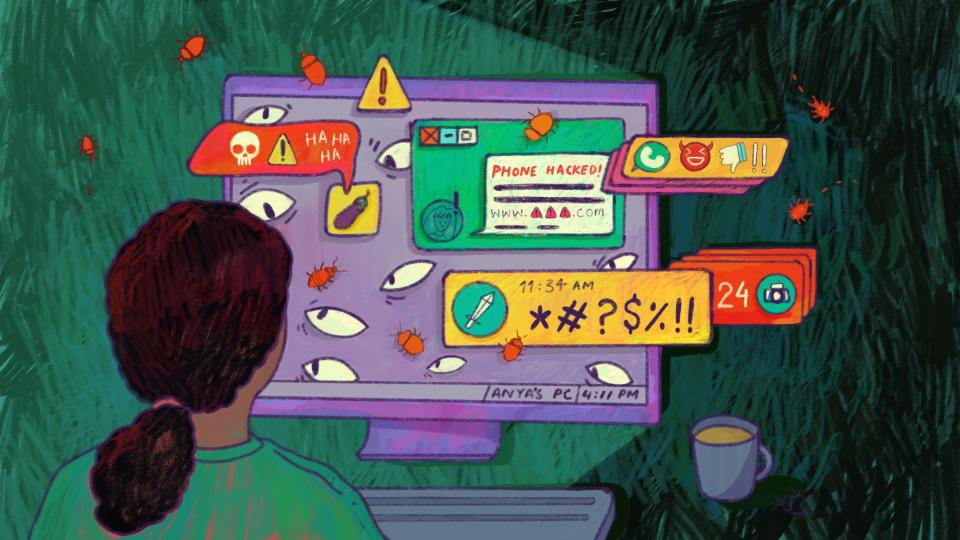
Illustration by Sabeen Yameen for GenderIT.org
As a writer, I know the creepy eyeballs that Zimbabwe’s state casts across oceans thanks to tech-enabled social media. But strolling down out a tram in Toronto’s Spaldina Street on a weak spring sun, I wasn’t prepared to meet a real victim of this mysterious stalkers’ army.
“It’s a shame I can’t show you my face even when I’m living in Canada, the West’s safest nation. My very iPhone 15 puts me in the stalkers’ arrow,” she told me, clapping her hands once, that cultural Zimbabwean show of surrender.
Social media stalkers, believed to be funded by the Zimbabwe government, have cast a surveillance fear that follows the country’s outspoken citizens at home and abroad, with women activists being specifically easy to pick off.
“It’s outspoken women like me who bear the vilest of digital insults,” says Anita Moyo*, 31, a Zimbabwe-born mother of one, living in Toronto, Canada. She hides her real name out of fear for her family still living in Zimbabwe.
When she tried to make a report to her local Canadian police branch in Peel suburb of Toronto, the female officer at the front-desk simply send her off ‘block the person on Facebook she said; we are powerless to arrest faceless stalkers overseas’.
Coordinated online stalkers channel body-shaming insults towards outspoken Zimbabwe’s women, is rife, be they political activists or gender rights advocates, at home and abroad.
“The stalker tactics often cap off with release of fake X, SMS, or WhatsApp photos or audios of women activists supposedly being in improper relations, like dating married men,” Moyo says.
Coordinated online stalkers channel body-shaming insults towards outspoken Zimbabwe’s women, is rife, be they political activists or gender rights advocates, at home and abroad.
‘Dad’s Army’
The name of the digital stalkers army working at the behest of the Zimbabwe regime is called ‘Varakashi’.
When translated from Zimbabwe’s vernacular Shona language, this means ‘Digital Destroyers’. No one knows the total number of workers in this online brigade, but Zimbabwe’s 82-year-old president, Mr. Emerson Mnangagwa, gave the clearest hint of the brigade’s existence in 2019 when he blurped:
“Some of us are old, clueless about these new tech platforms. You the young digital militants, jump in. Destroy the state’s enemies online, command the debate.”
A candid admission that this grotesque army of digital stalkers indeed exists, and enjoys allowance from a secret plush fund set aside by Zimbabwe’s authorities, came this year in January, when a senior leader of the party that has governed Zimbabwe for 40 years uninterrupted, circulated a letter showing he has relieved some of the ‘Varakashi’ digital spies of their jobs.
“It confirmed my worst fears, that the digital stalkers who inboxed me via Messenger in 2024, threatening to ‘leak’ supposedly intimate photos of me and my husband, are a real stalkers department working for the state,” Joyce Memba*, an activist who strongly advocates against the arrests, and jailing of female political activists in Zimbabwe, says about the personal of speaking at a protest outside the Zimbabwe embassy in South Africa.
When I met Memba in Pretoria in 2024, the capital of South Africa she was more terrified than Anita. Each time, she was holding a loudspeaker protesting out the Zimbabwe consulate amongst a crowd, she made it a mission to wind up her face with a cloth shaol to hide everything except her eyes. On her way home from the vigil, she would make sure she hops into a rundown Toyota taxi whilst her husband drove their SUV home, ‘to put of spies’, she said, briefly lowering her shaol cloth to sip a quick coffee. Unlike Canada, South Africa is separated by the mighty Limpopo River from Zimbabwe, so close that activists say, when the Zimbabwe regime wants to track down a dissident in South Africa, ‘online stalking would be the least of the victim’s worries’.
When 2019, the president of Zimbabwe boasted about giving the ‘Varakashi’ online stalkers their sending-off orders, an avalance of digital abuse and insane stalking of the state’s enemies was unleashed and has gained notoriety to this day.
It confirmed my worst fears, that the digital stalkers who inboxed me via Messenger in 2024, threatening to ‘leak’ supposedly intimate photos of me and my husband, are a real stalkers department working for the state.”
- Joyce Memba
“Their job description is ruthless and clear-cut: to surveil dissidents at home and abroad, to disrupt social media or e-news sites debate, to sow rapid fire digital misinformation and suppress criticism of Zimbabwe’s governing regime,” says Yasin Kakande, an Africanist, Zimbabwe expert and author.
Zimbabwe is a small nation in southern-most part of Africa, whose population is roughly 16 million. It has ravaging poverty and one of the world’s highest inflation rate, factors that have sent nearly 4 million of its citizens into economic and political exile in Europe, South Africa, North America and the Gulf Arab countries. According the think-tank Good Governance Africa, Zimbabwe is one of Africa’s most competitive autocracies, with a military-led government directing its affairs.
Modus operandi
The methods of the Varakashi social media stalkers are both brazen and subtle. Their fake Twitter or Facebook avatar might be an eggplant, a sword, or an AI-generated picture of a female Asian model, and they are so adept at evolving their online persona that a real male person working as a ‘Murakashi’ can quickly morphy into a fake female online when targeting a victim, says Silas Ndaba*, a former digital stalker working for Zimbabwe’s government, who spoke to Gender IT on condition that his real identity is protected.
“Behind the faked up image, is a real human, an official of Zimbabwe’s government outsourcing the dirty digital stalking to jobless youths. The target is to shame critics at home and abroad, like me,” says Anita Moyo, the victim.
Crass sexualisation of targets is one of the most effective digital shaming the ‘Varakashi’ use. This can be aptly illustrated in the experiences of leading Zimbabwe human rights lawyer, Ms Fadzayi Mahere, 39, aka ‘Irony Lady’
Mahere, a pro-democracy actor, prolific lawyer, and former lawmaker with a huge social media following is outspoken and has been jailed by Zimbabwe’s regime in the past. When she narrated the ‘cruel’ menstrual health violations she encountered whilst imprisoned in a female jail wing in 2021, the ‘Varakashi’ digital stalkers had a field day on X and Facebook, berating her for being ‘overage and unmarried woman’, and a ‘loose’ woman who deliberately walks around with no ‘underwear’.
Crass sexualisation of targets is one of the most effective digital shaming the ‘Varakashi’ use.
Zimbabwe is a country with one of Africa’s most gendered patriarchy beliefs, such that women who are 24 and above and unmarried are socially shamed as ‘second hand goods’.
“The Zimbabwean political space is not easy nor is it safe for women. For any women, but especially young women,” Chipo Dendere, a Zimbabwe-born professor at Wellesley College in the United States, told Al Jazeera of the hell of sexualised digital-stalking Fadzayi Mahere has to live with. “I often find myself holding my breath - to see Mahere remain active online,” she lamented.
Prolific stalking
The ‘Varakashi’, are prolific says Kakande, the analyst. “They’re remarkable, and don’t sleep, it appears.” Each time a female critic of the government of Zimbabwe puts out their opinions rebuking the state for corruption, violence or stiffling of citizens’ freedoms, the ‘Varakashi’ stalkers spring up on X, Facebook, Youtube, or WhatsApp. Suspicious, and new social media accounts — with ‘avatars — are registered in minutes, and they jump straight into the chatlines with insults, threats, and porn or forex scams spam.
Informative chat threads on issues that affect the lives of Zimbabwe citizens are aggressively spammed, and eventually polluted, with a flood of hyperlinks and insults. The real debate veers into the mud, and sometimes, direct threats are thrown into the debate such that women who are critical of Zimbabwe’s state leadership ultimately self-censor, fearful that their families are being watched covertly.
“For me, it took the form of getting blunt threats in my [Twitter] inbox with messaging like ‘we know who you’re sleeping with’, says victim Moyo.
Some of ‘Varakashi’ digital stalkers working for the Zimbabwe state can sometimes trip and expose themselves as very senior state officials who are moonlighting as cheap, thoughtless digital stalkers living fake personas online. This happened in 2021 when Mr Nick Mangwana, the spokesperson for Zimbabwe’s president (a very senior civil servant) temporarily lost guard and mistakenly outed himself as a stalker operating operating fake pro-Zanu PF accounts of @nicolehondo and @CharityMaodza on X.
Direct threats are thrown into the debate such that women who are critical of Zimbabwe’s state leadership ultimately self-censor, fearful that their families are being watched covertly.
“It was cruelly laughable to see him in real time posting something under his real name, forgetting about switching his iPhones or accounts to a fake one, and jumping to comment on his own post under a fake follower account,” Moyo says of the incident.
Outsourced e-stalking
"The reason why there’s an endless supply of tech-savvy youths willing to take up the shameful job of being a ‘Varakashi’ digital stalkers on the employ of Zimbabwe’s police is ‘educated poverty’," says Silas Ndaba*, the former digital stalker who now spills the beans to ‘clear his conscience’ as he says to GenderIT.
Ndaba, 28, is highly educated, a marketing graduate who studied at the premier University of Zimbabwe, but was never employed until he feared for his future. His predicament fits that of millions of Zimbabwe’s millennials, highly educated but very jobless and earning a living doing humiliating jobs like hawking cigarettes on the capital’s streets. “I wanted to put food on the table, got hired as a ‘Varakashi’ digital stalker,” he says.
Zimbabwe’s ‘Varakashi’ crudely retraumatise exiled survivors of torture and state repression especially women, says Anita Moyo, who once spent a weekend in jail after being swept in an arrest of pro-democracy protesters in Zimbabwe. The ‘leaking’ of fake or genuine, but hacked pictures/audios/ videos of intimate private letters, location ID details, is an online blackmail tool to that crushes the spirits of outspoken women at home, and ‘follows us into the diaspora’.
“It’s some sort of Big Brother from Harare snooping into your bedroom life as far as Toronto, Johannesburg, London, Dubai,” she says.
That some autocratic African regimes can pay digital stalkers to pursue outspoken activists is a phenomena repeated across the continent, not just in Zimbabwe, says Kakande, who himself has had the government of his native Uganda allegedly sending online phishing stalkers to lure him via PayPal and Facebook, and try to obtain his sensitive personal information.
The reason why there’s an endless supply of tech-savvy youths willing to take up the shameful job of being a ‘Varakashi’ digital stalkers on the employ of Zimbabwe’s police is ‘educated poverty’.
- Silas Ndaba*, former digital stalker
Emerging AI and social media technologies have created a dark industry of low-cost, outsourced, ruthless state-led online surveillance actors that jump across the borders to suppress Africans living in exile abroad. Boots and human spies are no longer needed. Just an iPhone, Android phone, laptop and internet connection, a Zimbabwean female politician living 9000 miles away in London can have her thoughts ‘arrested’ on X, Facebook, Instagram or Youtube by a state-agent in Harare, Zimbabwe 9000 miles away. “Just threating via inbox to leak her ‘fake’ nude pictures is enough to silence her,” says Kakande.
It dawned on me that my very iPhone which I use aggressively for Twitter or Facebook as a writer, could be a door to a flood of digital stalking if the Zimbabwe regime wants to scratch its claws against my cheeks. As I chopped vegetables for the evening meal upon finalising this story, I took a deep sigh and breathed: for an outspoken women from Zimbabwe, living abroad, it takes just a single AI-faked nude images engineered by the regime back home, and released to X or Facebook to defame, soil and silence an innocent woman – for good.
- 179 views




Add new comment